Welcome to my inner mind.
Collection: Accordion – (In progress)
50L/20L
I am a steel-toed botted priest,
minister to a congregation of empty vessels.
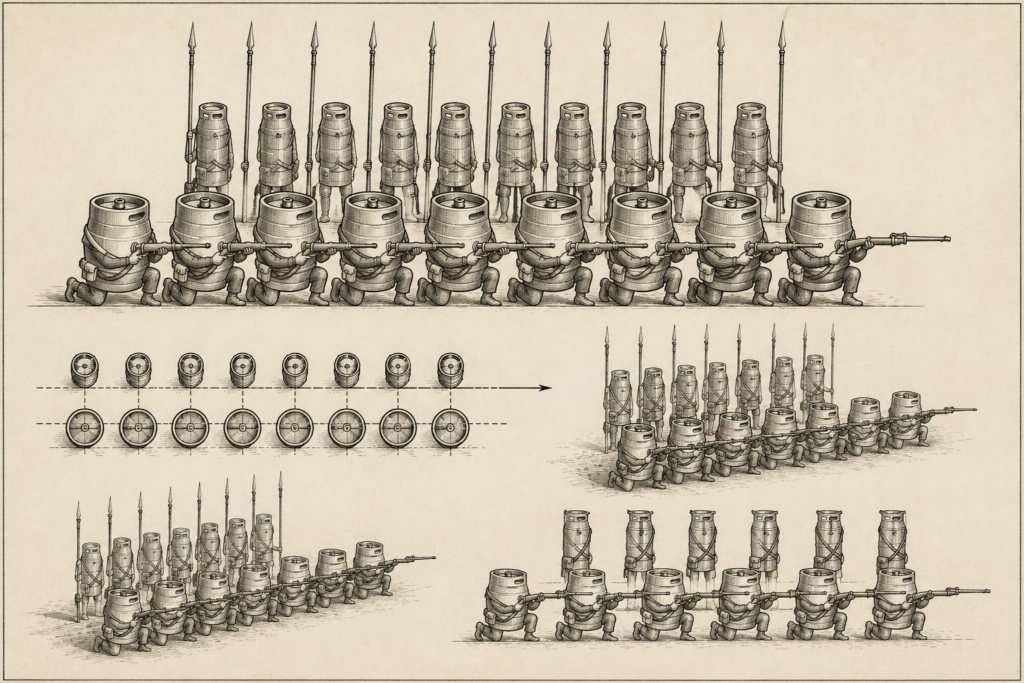
They stand in British ranks– the broad ones kneeling, the slender ones standing behind,
motionless between volleys, disciplined,
awaiting orders.
I bless them with steam and sanitizer, anoint them with hot caustic,
absolve them with cold rinse.
One by one I send them into the world, knowing each will return to me bearing the fingerprints of celebration,
the sediment of labour, the residue of another ordinary miracle.
Nothing made for living stays clean. The washer hisses its liturgy. Valves chant. Steel answers steel.
There is always another vessel. Always another cleansing.
Always another beginning.
Collection: Urban – 14/aug/2025
home-style-county Pie
Travelling, travelling, travelling– I have slept beneath so many roofs that even my shadow has forgotten where it belongs.
I once believed arrival would eventually become belonging.
Instead, the city gave me an address and no place to call home.
Two in the morning is a country open only to the sleepless:
the nurse returning from her shift,
the lover with nowhere left to return,
the woman carrying her shoes in one hand,
the lonely man carrying everything he owns upon his back.
Faces from every life wander its streets, made equal not by justice, but by exhaustion.
At this hour, the city is almost honest.
No one has the strength to pretend they are not alone.
At the end of the block,
a fluorescent glare spilled onto the pavement.
I followed it.
Inside, refrigerators hummed.
The ceiling shone white enough to erase every shadow.
while neon sang its thin electric note,
drawing the night-worn toward the glass
as blue light gathers insects.
I passed through gates made of melted sand
and found, beyond them,
three cheerful words:
HOME-STYLE COUNTRY PIE.
Home.
Country.
The city had learned how to package both.
but the pie didn’t taste of any country I knew of.
Perhaps home is the first thing a city learns to counterfeit.
Around me, strangers ate
beneath the unforgiving lights,
never meeting one another’s eyes, yet unwilling to leave.
Perhaps loneliness simply needs a room in which to sit.
At two in the morning,
the convenience store becomes
the city’s last public room:
The place sold every convenience except belonging.
So I left.
Outside, a man had built a room from cardboard and a sleeping bag against the marble wall of a bank.
I gave him what remained in my pocket.
He pointed toward a café
that stayed open until dawn.
The man without an address
was the only person who could tell me where to go.
Now I sit in a café outside of time.
A tired server wipes the same circle
from the counter as though the hour might disappear beneath the cloth.
From the ceiling speakers,
a symphony moved among glass cups and empty chairs.
The server placed a cup before me.
Steam rose between my hands.
She did asked where I had come from
“Just down the street,” I said
Outside, the sky began to pale.
The neon went dark.
One by one,
the office windows kindled.
Slowly, the café window
stopped being a mirror.
The city has not awakened.
It has only changed its lights
and taught us to call that morning.
What We Wore
When I lived in the heart of the city,
an older woman walked beside me
toward a tower made of glass.
Before she offered the street a word,
everything she wore
began speaking for her.
The watch spoke first.
Bright against her wrist,
it measured each second aloud:
“She has prospered.
Her hours are precious.
Do not keep her waiting.”
Then her heels struck the pavement:
“She does not tire.
She does not bend.
Make way.”
Yet at every crossing,
she shifted her weight
from one foot to the other.
Her feet asked quietly for mercy.
Her heels refused
to translate.
The wind caught her red dress,
and the fabric lifted its voice:
“She has not consented to disappear.
Turn your head.
She is still here.”
Above her dark hair, now threaded with silvery age, a fascinator leaned toward the sky and made its elegant declaration:
“She is expected.
She is celebrated.
Nothing has been lost.”
Everything she wore
spoke in a language
the city understood:
wealth,
certainty,
importance,
visibility.
Perhaps nothing they said
was entirely false.
That was the sorrow of it.
Each one told a truth
too small to contain her.
Her hands carried
the pale seams of years.
Her eyes remained fixed
upon some private distance.
Her mouth held a sentence
none of her adornments
knew how to pronounce.
And beneath all their declarations,
her heart continued beating–
low and unadorned,
like someone waiting
to be asked a question.
I wondered whether these
were the words
her heart had asked them to say,
or merely the passwords
the city required
before it would open its doors.
The city understood every word.
It has always been more fluent
in objects than in people.
The glass doors parted at her approach.
She entered without ever having spoken.
Then the moving glass
caught us both. Our reflections crossed.
For one moment,
I wore her red, and she wore my watching face.
Then the glass separated us.
She entered.
I kept walking.
A Well-Dressed Emergency
Where will the rain fall tonight?
Upon two lovers
beneath one coat?
Upon the bowed head of a musician
shielding his violin with his body?
Upon a child receiving the sky
with an open mouth?
Upon the blue tarpaulin
someone calls a roof?
The rain does not know
the names we give these lives.
It has no word for lover,
no word for homeless,
no word for silk
or skin.
It falls.
Once each month,
when the forecast promised rain,
I dressed myself
in my finest suit.
I knotted silk at my throat
and polished my shoes
until the city could see
its own face in them.
Then I found a bench
where everyone walked
as though they had somewhere
important to be,
and waited for the weather
to undo me.
I let the rain enter my collar,
erase the crease from my trousers,
gather inside my pockets
and fill my polished boots
until the cold closed
around my ankles.
Then the city noticed.
Umbrellas broke formation.
Strangers stepped out
of the moving crowd.
Hands came gently
to my shoulder.
“Are you all right, sir?”
“Has something happened?”
“Can I call someone?”
“Do you have somewhere to go?”
They knew nothing about me.
My clothes had simply told them
that concern was appropriate.
A few yards away,
another man sat beneath a blanket
darkened by the same rain.
No umbrella changed direction.
No hand reached for his shoulder.
No one asked
where he would go.
Upon me,
the rain became an emergency.
Upon him,
it remained weather.
Neither of us had spoken.
Our clothes had already testified.
Mine said:
Something has happened to him.
His said:
This is what he is.
The city knows how to pity
a man who has fallen.
It has little mercy
for those it imagines
have always lived upon the ground.
But I had arranged my fall.
It began with a forecast
and would end at my front door.
At any moment,
I could stand,
return to a dry room,
remove the suit
and become respectable again.
My suffering had an exit.
His did not.
I went home.
That is the part
I must not make beautiful.
I poured the water
from my boots,
peeled the wet fabric
from my body
and hung my authority
beside the door to dry.
I do not know
where the other man went.
That, too, is part of the poem.
The rain had no dress code.
Mercy did.
The Black Pigeon
We buried the rivers
beneath our streets.
We taught trees
to live in squares,
their roots held down by iron.
We sealed the earth beneath stone
and raised grey towers
until even the sky appeared
to belong to them.
Every living thing
was given a place:
flowers in boxes,
grass behind railings,
people behind glass.
Only the pigeons lived
as though none of this
had been agreed.
They nested inside the names of banks,
drank rain from gutters
and fed on what fell from our hands.
We called them vermin
because they survived
without our permission.
Once, people watched birds
to learn what the gods intended.
Now we watched screens
to learn what to want.
The old magic had not vanished.
It had learned to live
on ledges and crumbs,
waiting above us
for someone to look up.
That afternoon,
the wind followed me
down the avenue.
I was one more commuter on foot,
walking home with the authority
of a man who knew exactly
where he was going.
I did not move with the crowd
so much as through it.
I had learned the grammar
of fast walkers:
eyes forward,
pace unbroken,
purpose made visible.
The city gives right of way
to anyone who looks
as though he cannot be delayed.
Around me, faces bent
toward the pavement
or the blue light of screens.
If two pairs of eyes met,
one turned away- the small courtesy of pretending not to see.
I passed through a tunnel
and entered the city square,
where the five-o’clock flood
poured from every office door.
I turned one shoulder
and began to carve
a path through it.
Then I stopped.
The flow divided around me
and sealed itself again behind.
Above the passing heads,
a black pigeon sat
on the narrow rim
of an advertisement
for beauty.
Beneath its feet,
a woman’s face had been polished for every season.
The pigeon watched
the crowd pass below.
Then it met my eyes.
It was as though
the black pigeon was waiting for one person to look up.
At that moment,
the wind entered the square
with the force of something
that had not agreed
to be shut out.
It passed through every layer.
For one breath,
I stood unclothed
inside my clothes.
It was in that moment while awake – I awoke.
A message had been given to me by the wing and the wind: “leave”
In a fortnight I gave up my title and the six figure salary-
and the borrowed authority
with which I had crossed the square.
I left not because
I understood the omen,
but because
I could no longer pretend
I had not received it.
Collection: Deep Breath – 24/nov/2024
Substance & Silence
I have not written you a poem,
though all night your name kept watch within me.
Nor have I knelt before you,
though my silence has been kneeling
since the hour I first knew you.
For what can words carry
across the distance fear has made between two hearts?
Even rain, falling upon a
shuttered house,
must spend its song upon the
roof.
But do not mistake silence for emptiness.
The seed makes no confession beneath the soil, yet from its darkness a forest rises.
Substance dwells in such hidden things:
in the breath withheld before a truth,
in the hand that crosses half the distance
and waits for another hand to answer,
in the laughter that remains within a room
long after the beloved has gone.
You ask me to reveal
what refuses to be spoken.
But does the moon descend
to place its silver in your palm?
It passes quietly over the sleeping earth,
and the sea rises to meet it.
Its proof is not the light it claims,
but the tide it awakens.
And if I knelt
and laid a verse before your feet,
would the bending of my body
tell you what my pride has already surrendered?
Perhaps you would laugh–
not from cruelty,
but because every gesture becomes small
before the thing it longs to contain.
A cup may carry the wine,
but it cannot carry the vineyard,
the sun that ripened the grape,
or the winter the vine endured.
So do not seek my heart
only within these words.
Seek it in the fire that outlives them:
in what I remembered
when forgetting would have been easier,
in what I protected when no eyes were upon me, in the door I left open even after hope had departed.
Substance is not the weight of everything we say.
It is what remains when the saying is done: the unseen gravity by which one soul alters the course of another.
And silence is not
the absence of a poem.
It is the country
from which all poems come.
Therefore, beloved,
I shall neither kneel
nor command these words to prove me.
I will sit beside you without defence
and place my silence between us.
And should you enter it,
you will find your name
written everywhere
I had no words to place it.
Je t’aime, mon colibri
Was it fate that gathered our loose threads,
or love –young and impatient–
that began its weaving
before time had built the loom?
We came to one another as strangers,
yet love has never believed in strangers.
It recognizes the soul before the name,
as the sky recognizes the wing
before the bird has taken flight.
Rest your head upon my bones tonight.
They have carried me through every storm;
let them, for once, carry your dreaming.
Forgive this hollow house.
It owns one chair, one lamp, and more echo than furniture. Yet everything I possess within me is waiting here for you, and no house is empty when one heart welcomes another.
Tell me your stories–
those you have taught to smile in daylight,
and those that tremble when spoken aloud.
I will not ask them to be beautiful.
I will give them my ear
and the silence surrounding it
until morning unfastens the night
from the window.
Je t’aime, mon beau colibri.
We were two frightened lovers
who fell before time had prepared the earth beneath us.
There was no hour in which to hide,
no later day to which we could entrust our courage.
For love, when it comes as lightning,
does not ask the sky’s permission to blaze.
You were my coup de foudre–
the lightning by which I saw,
for one astonished moment,
the whole country of my heart.
Yet because I love you,
I will not close my hand around you.
A hummingbird held too tightly
becomes not a wonder, but a wound.
And love that builds a cage
has mistaken possession for devotion.
So fly, mon colibri.
Take the sky that has been calling you.
My hands will ache with your absence,
but they will remain open.
For the hand that blesses the wing
must also bless the sky that receives it.
Do not promise me forever.
Forever is too heavy a burden for wings.
Say only that if the winds of another season
carry you again toward this door,
you will enter without fear
and rest your head upon my bones once more.
I will miss you many times:
Once when morning finds
your place untouched.
Once when laughter searches
the room for your voice.
Once when a flower opens at the window
and waits for the bright answer
of your wings.
And once –without knowing it– I will remember you for the last time.
And I will miss you in ways
for which no hour
has yet invented a name.
But tonight has not yet left us.
So before dawn divides our roads,
place your hand in mine.
Let us dance– not as lovers to whom eternity was promised, but until our breathing becomes the final music in the room.
Will you dance with me tonight,
mon beau colibri– not because morning will keep us, but because it will not?
The Trail
like red leaves shaken loose before winter.
Drop by drop, it made a road–
perhaps that I might follow it home,
or perhaps that you might follow it to me.
I carried my confession into the desert, for the desert has heard every sorrow and judged none.
It received all that I could not bear
and answered only with silence…
that ancient mercy by which the earth listens.
Beside the flame I sat
while wind and fire disputed like old friends.
Each resisted the other,
yet neither desired the other’s ruin.
And I asked the darkness:
Why could we not contend so?
Why did our truth require a wound?
At dawn, I woke beside a vanished flame.
Only embers remained–
red eyes beneath the ash,
yearning for the brightness they had been.
But perhaps the ember does not mourn the flame.
Perhaps it is the heart alone
that cannot bless what has ended.
By then, my wound had closed its mouth.
The blood upon the fallen leaves
had darkened into rust.
I followed them home beneath my feet,
as I had once followed my father’s voice–
not calling from somewhere ahead,
but rising from within me.
Each leaf broke
with the small sound of farewell.
With every farewell, I remembered.
With every breaking, I found the way.
At the threshold of home, I drew one breath–
deep enough to make room for myself again.
Then I bent to the wound
and licked it until it learned
the shape of a scar.
I gave it a place among its elders–
not as a trophy of suffering,
but as witness that pain had entered me
and had not made its dwelling there.
I have tried.
I have failed.
I shall try again.
The tree does not conceal
where lightning entered it.
It bends around the wound
and continues toward the sun.
I wear my scars openly,
not because pain is holy,
but because healing is.
They are the scripture of my becoming,
and each one bears the same testimony:
Life wounded me,
and still,
I did not withdraw my love from life.